Making linen-wrapped birch panels
I recently made panels from birch plywood with linen mounted on them. One is for an existing frame I have, and the others for common sizes I can get ready-made frames for (an important consideration).
Below is my process
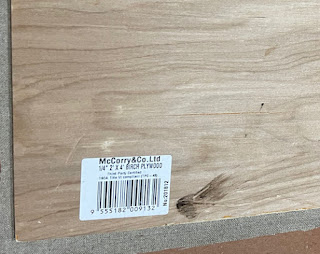 |
The wood is 1/4" thick birch plywood that I bought at Lowe's in a 2' x 4' sheet: |
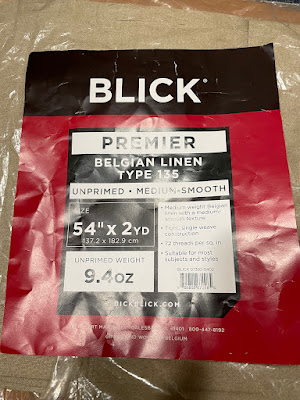 |
Blick Premier Belgian Linen type 135 unprimed, medium, smooth |
For gesso, on 2 of the panels I used Michael Harding. I am experimenting with clear gessoes and tried Winsor & Newton's on the other panel this time around.
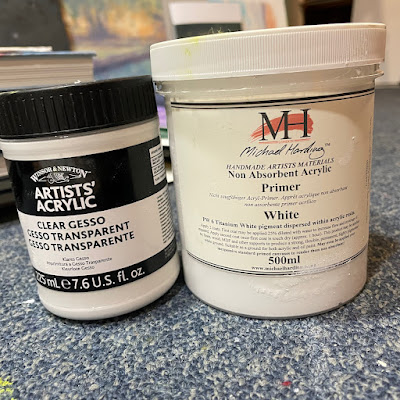
NOTE:
From some reading, I have become aware that I should be doing a coat on the bare wood before the gesso, as a moisture barrier/sealant. I read of some artists using a product like Zinsser "bulls-eye" shellac. I will try this for the next round...
Carrying on, after I cut the panels, I do a light sanding on the edges. (I hand-saw these and wind up with little splits along the edge.)
Using a brush, I then coat a side of a board with Lineco glue and attach the linen to it.
I will use a brayer to make sure it gets evenly pressed on. I leave a reasonable margin of linen beyond the panel.


I then put a weight on them to press down - usually a stack of art books.
I have dealt with the edges differently. Sometimes I have just cut them flush to the front. Other times, I will wrap them around to the back. This time I wrapped them around and glued them to the sides. I then needed to do that as another step.
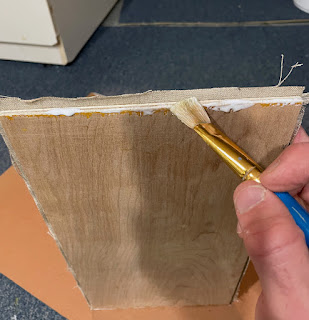 |
| getting the glue on the edges |
 |
| the edge after gluing After that, 3 coats of gesso with sanding in between each |
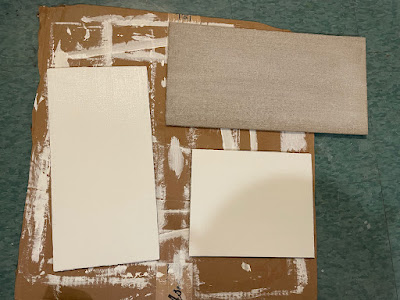 |
| what they look like while drying The clear gesso (top right) looks milky when wet, but dries clear |
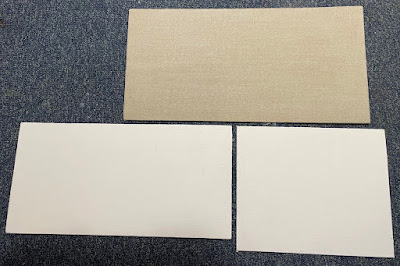 |
| The finished panels |
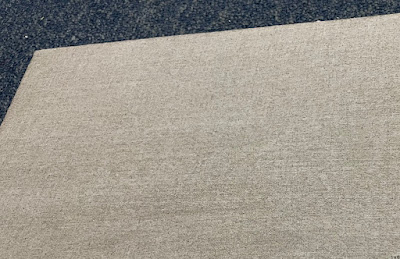 |
| close up or texture of clear coated panel |
 |
| close up of panel with white gesso |
Conclusions:
Three things to probably improve this process and/or the quality of the resultant panels:
1. Finally get a power saw of some kind
2. Use the finer (portrait) grade linen
3. Put down a coat of some protecting varnish before gesso
4. Apply 4 coats of gesso, rather than 3
I do think the Winsor & Newton Gesso feels better than the Liquitex. The Liquitex seemed to have too much pumice in it. But I won't know for sure until I make a picture on it.


